I check before I decide whether to run the Esplanade or just walk to the T. The first stop is always the state. MassDEP forecasts fine particles every single day of the year, adds ozone through the warm months, and puts both on a public map that costs nothing to open.
Then there's the geography. Boston sits on a harbor at the end of a long pollution transport corridor, so a wind shift can move the reading inside an hour. The number you saw at breakfast doesn't necessarily describe your four o'clock.
TL;DR Quick Answers
Air Quality Boston
Boston air quality is good or moderate on most days. Across 2025, Massachusetts recorded only ten unhealthy days statewide, six for ozone and four driven by wildfire smoke. Check MassDEP or AirNow for today's reading, and keep in mind that a citywide number can hide a worse block.
Official source: MassDEP forecasts fine particles every day of the year and adds ozone through the warm season, publishing both on a free public map.
Act at 100, not 150. The threshold you can actually feel sits well above the one that matters for asthma, older adults, and kids.
Boston proper beats its own metro grade. Suffolk County ranks among the cleanest counties in the country for daily particle pollution. The metro's failing grade comes from Essex County, well north of the city.
Summer and winter are different problems. Afternoon ozone drives warm-season readings. Cold, still mornings trap fine particles near the ground.
Fastest smoke check: the AirNow Fire and Smoke Map, which shows Canadian wildfire plumes before they reach you.
Why it matters indoors: the outdoor number sets the workload for your filter, since your home pulls in the same air the monitors are reading.
Top Takeaways
Three tools, three jobs. State forecast for the day, neighborhood sensor for your block, weather forecast for whether it holds.
Act at 100, not 150. The threshold you can feel sits well above the threshold that matters.
MassDEP forecasts fine particles here year round and treats ozone as a warm-season problem. Checking only in summer misses half of it.
A metro grade reflects its worst county, and for the Boston metro that county sits well north of the city. Look up your own before you draw conclusions.
Outdoor readings set the workload for your indoor filtration, so a loaded filter cancels out an otherwise good habit.
The Same Number Means Two Different Things in July and January
You already know the color bands. Under 50 is good, 51 to 100 is moderate, and once it clears 100, people with asthma, older adults, and kids should ease off hard outdoor effort.
What the bands hide is which pollutant is driving them. Summer heat cooks tailpipe emissions into ground-level ozone, and that peaks mid to late afternoon. Fine particles run all year, spiking when wildfire smoke arrives or when a cold, still morning traps everything near the ground. So a 90 in July and a 90 in January describe two different problems, and each one asks something different of you.
Why Two Apps Disagree About the Same Street Corner
This trips up more people than anything else in air quality data.
Regulatory monitors are federally sited reference instruments, calibrated and quality-assured, and every official forecast and alert in Massachusetts rests on them. Low-cost sensors are inexpensive optical devices that read particle scatter, and hundreds of them sit on porches and school roofs across the state.
Both tell the truth as they see it. Regulatory monitors are accurate but sparse, so your nearest one might sit four miles away in a different microclimate. Neighborhood sensors sit on your block and tend to read high in humid or foggy air, which describes most of a Boston spring morning, making top air filters a useful indoor complement when outdoor readings vary from one location to another.
Here's how I use them. The official reading tells me what the day looks like. The neighborhood sensor tells me whether my particular street is running worse than the city average. And I treat any single sensor as a signal, not a measurement.
Four Things That Move Boston Air Faster Than You'd Expect
Sea breeze can flip conditions by early afternoon, pushing marine air inland and changing what the monitors see. Temperature inversions park a lid over the harbor and hold pollutants at ground level, usually on cold, still mornings. Traffic on I-93 and the surrounding corridor sets a baseline that rises and falls with rush hour. Canadian wildfire smoke shows up from a thousand miles out with almost no local warning.
Put those together and a morning check stops being enough. I learned to look twice on days when forecasters expect the wind direction to shift, which is information a weather forecast hands you and an air quality app doesn't. Keeping up with HVAC system repair helps make sure your indoor system is ready to respond when those outdoor changes affect the air coming inside.
What the Outdoor Number Means for the Air Inside
Your house breathes whether you want it to or not. Air moves through door gaps, exhaust fans, and every cycle of your heating and cooling system, so outdoor conditions set the workload for whatever filtration you own. On a high particle day, the return vent pulls in the same fine particulate the monitors report out on the street, and your filter is the only thing standing between that air and the room you're sitting in.
Which makes the case for pairing your forecast habit with a live Boston AQI map and an honest look at your own equipment. A filter that's gone grey and loaded can't capture much of anything, and the restricted airflow makes the system work harder for less return. Same goes for ductwork and the dryer vent, where built-up lint and dust become an indoor source that has nothing to do with the weather. Checking the outdoor number only pays off when the indoor side can act on it. Pleated furnace filters help support that indoor response by capturing airborne particles as air moves through the system.
"The mistake I see constantly is people treating the AQI as a summer ozone metric. In Massachusetts we forecast fine particles every single day of the year, and the worst particle episodes I've handled weren't heat waves. They were still, cold mornings with an inversion sitting over the harbor and wood smoke with nowhere to go. If you only check the index in July, you're missing half the story."
7 Essential Resources
These are sorted by the job each one does, so open the first and add the others as you need them.
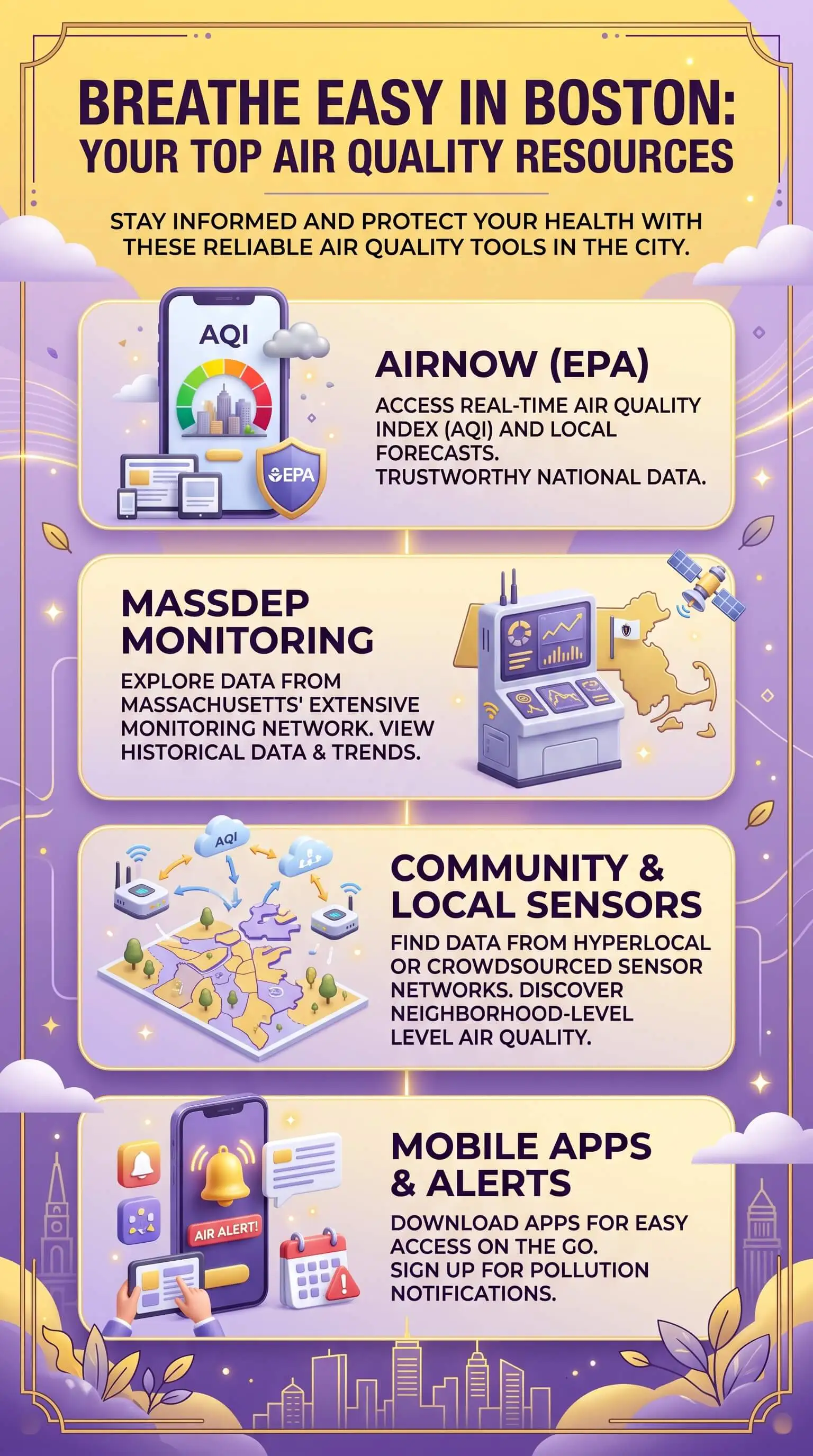
1. The State Source That Forecasts Particles 365 Days a Year
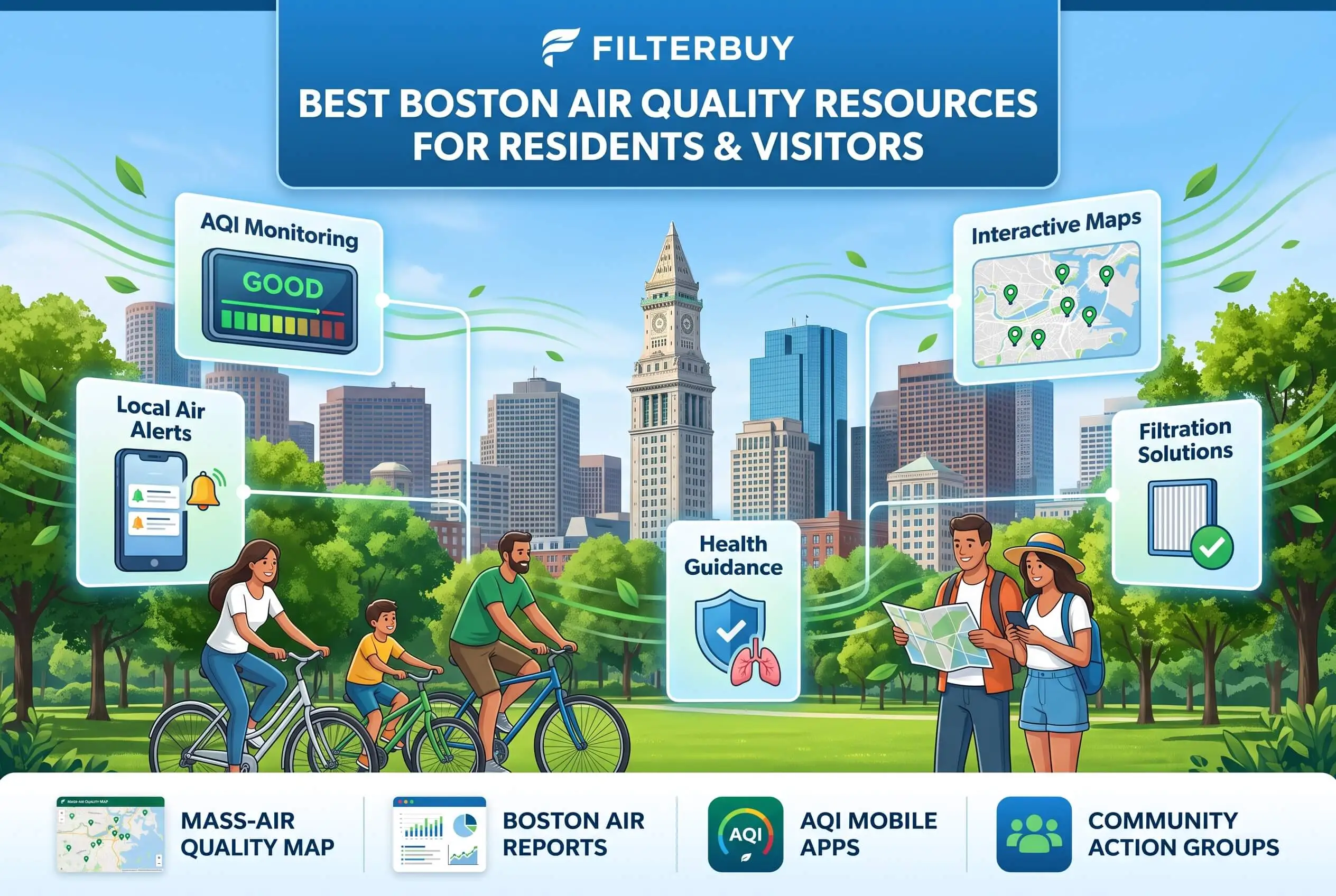
MassDEP runs the statewide monitoring network and publishes daily forecasts through MassAir Online. The agency forecasts fine particles year round, adds ozone through the warm season, and issues open burning advisories from January into May. There's also a hotline at 1-800-882-1497 if you'd rather hear the forecast than load it, which matters more than you'd think when your signal drops underground. Source: Massachusetts Department of Environmental Protection, Air Monitoring in Massachusetts
2. The Federal Reading Every Other App Is Quoting
AirNow carries current conditions and next-day forecasts for Massachusetts reporting areas, pulled from the same regulatory monitors the state operates. When a weather app shows you an AQI, this is almost certainly where that number came from, minus the context. Source: U.S. Environmental Protection Agency, AirNow Massachusetts
3. Early Warning for Smoke That Started a Thousand Miles Away
The Fire and Smoke Map blends regulatory monitors with the low-cost sensor network and lays smoke plumes over the top, which makes it the fastest way to spot transported wildfire smoke before it reaches you. Readings from the state's community sensor grants show up here too. Source: EPA and U.S. Forest Service, AirNow Fire and Smoke Map
4. The Forecast That Tells You Whether the Number Will Hold
Air quality tools describe the air right now. The National Weather Service office covering Boston tells you whether the wind is about to shift, whether an inversion is setting up, and whether heat is building, which is what actually decides your afternoon. It posts air quality alerts alongside its other hazard products. Source: NOAA National Weather Service Boston and Norton, weather.gov/box
5. Neighborhood Data Instead of a Citywide Average
The state health department publishes modeled and monitored ozone and fine particle data down to the census tract, which is the scale where a citywide average stops being useful. Worth an hour of your time if you're choosing a neighborhood or a school. Source: Massachusetts Environmental Public Health Tracking, Outdoor Air Quality
6. Plain-Language Guidance in More Than a Dozen Languages
The state health department publishes a short climate fact sheet on poor outdoor air quality, covering who faces higher risk and what to do about it, translated into a long list of languages. In a city where a large share of households speak something other than English at home, this is the resource most roundups leave out and the one most likely to reach somebody who needs it. Source: Massachusetts Department of Public Health, Climate Fact Sheet: Poor Outdoor Air Quality
7. What to Actually Do at Each Level of the Scale
The CDC page turns AQI bands into behavior, with specific guidance for asthma, COPD, heart conditions, children, and people who work outdoors. Its advice for travelers is the part visitors should read before booking anything. Source: Centers for Disease Control and Prevention, About Air Quality
3 Statistics
The Metro Grade Doesn't Describe Boston
The Boston-Worcester-Providence metro dropped to a failing grade for daily fine particle pollution in the 2026 report, ranking 53rd worst in the nation, down from 114th. Read the county detail and the picture turns over. Essex County, north of the city, earned the state's only F and dragged that ranking down by itself. Suffolk, Middlesex, and Norfolk improved enough to land among the cleanest counties in the country on that same measure. Suffolk County is Boston. Source: American Lung Association, State of the Air 2026, Massachusetts
Unhealthy Days Are Rare, and They Cluster
MassDEP watches air quality at 26 stations statewide. Across 2025 the agency recorded six days with unhealthy ozone, four in June and two in August, plus four days of unhealthy fine particulate driven mostly by Canadian wildfire smoke. Ten days out of 365. Catching them is the entire reason to look. Source: Massachusetts Department of Environmental Protection, MassDEP Launches Two New Air Monitoring Stations
Massachusetts Asthma Rates Run Well Above the National Average
In 2021, an estimated 16.6% of Massachusetts adults and 9.7% of children reported having asthma, against 14.6% and 6.5% nationally. More households here have a direct, personal reason to care about a moderate day than in most of the country. Source: Massachusetts Environmental Public Health Tracking, Asthma
14.6% and 6.5% nvBoston’s air quality is often better than the broader metro grade suggests, but unhealthy ozone and particle days still occur, especially during summer and wildfire smoke events, making MERV 8 pleated HVAC furnace air filters a practical part of keeping indoor particle levels lower when outdoor air worsens.
Final Thoughts and Opinion
Here's my honest read after years of watching these numbers. Most people check air quality too late and too rarely, then overcorrect by installing four apps they stop opening within a month. One bookmark you actually use beats a collection you ignore.
I'd also push back on how metro-level grades get reported. A failing grade for the Boston metro is technically accurate and practically misleading, because the metro stretches across three states and gets graded on its worst county. If you live in Boston proper, your county currently ranks among the cleanest in the country for daily particle pollution. Worth knowing. It's also not what the headline said.
And the limitation deserves saying plainly, because plenty of people selling air products won't say it. No filter and no habit removes your exposure to outdoor air pollution. Good filtration cuts the dose your household breathes indoors, and on those ten or so bad days a year, that reduction is the whole point. Anybody promising you more than that is selling something.
Frequently Asked Questions
Is the air quality bad in Boston today?
Probably not. Massachusetts recorded around ten unhealthy days across all of 2025, counting ozone and fine particles together. For today specifically, check the state forecast or the federal reading for your reporting area rather than a national average, because conditions here move within hours.
What time of day is Boston air quality worst?
That depends on the pollutant, and the two answers sit at opposite ends of the day. Ozone builds through warm afternoons. Fine particles more often peak early in the morning, when cold, still air traps them near the ground. Which is exactly why one daily check isn't always enough.
Does Boston get wildfire smoke?
Yes, and it has become one of the main drivers of unhealthy particle days here. Canadian wildfire smoke accounted for most of the unhealthy fine particulate days the state recorded in 2025. It arrives with very little local warning, so a smoke-specific map earns its place next to a general AQI tool.
Should visitors with asthma change plans on a moderate day?
Adjust rather than cancel. Moderate means most people won't notice anything while sensitive individuals might. Shift a long outdoor walk to the morning during ozone season, keep quick-relief medication somewhere you can reach it, and check again before an afternoon activity. Hotel filtration varies wildly, so closing the window during a high reading does more than you'd guess. An air purifier for allergies gives you another way to reduce airborne particles in the room during your stay.
Why does my air quality app show a different location name than it used to?
Because the state changed them. In late 2025 MassDEP realigned its air quality forecast regions to match National Weather Service zones and renamed most of them. Saved locations in AirNow and existing email alert subscriptions may now point at a region that no longer carries that name. Open your app and confirm the place you saved is still the place you meant.
Bookmark One Boston Air Quality Resource Before You Need It
Pick the single source from this list that fits how you actually make decisions and park it next to your weather app, so checking becomes something you do without thinking about it. Then go look at your return vent, because the outdoor number only earns its keep when the indoor side can do something about it, and professional air quality testing can give you a clearer picture of what is actually happening inside.