After manufacturing over 50 million filters and analyzing data from two million households, here's what surprises most families near busy roads: the pollution coming through your windows isn't your biggest problem.
It's what's already inside.
The Highway Pollution Reality Most Homeowners Miss:
Highway traffic generates three types of pollution:
Ultrafine particles (0.01-0.1 microns) from exhaust—too small for MERV 11
Fine particles (2.5 microns) from tire wear, brake dust—MERV 11 captures 85-90%
Coarse particles (10 microns) from road dust—MERV 11 captures 95%+
Here's the insight from our manufacturing floor: roughly 60% of customers near highways upgrade to MERV 11 targeting exhaust fumes, then feel disappointed when they still smell diesel. They're fighting the wrong battle.
Exhaust fumes are gases (VOCs), not particles. MERV 11 can't capture what measures 10,000 times smaller than its media trap.
What Actually Works for Highway Homes:
After serving thousands of families living within 500 feet of major highways, we've discovered the best value comes from understanding which highway pollutants MERV 11 air filters handle—and which require completely different solutions.
This guide reveals:
Which highway pollutants MERV 11 actually captures (and which slip through)
Why location matters more than rating (500 feet vs. 1,000 feet changes everything)
How to combine MERV 11 with activated carbon for complete protection
Whether your HVAC system can handle the upgrade without wasting energy
Real-world filter performance data from homes near highways in our service areas
Why this matters for your family:
The EPA reports Americans spend 90% of time indoors where pollutant concentrations run 2-5 times higher than outdoors. Near highways, outdoor pollution compounds indoor problems—but only if you let it inside.
Smart filtration stops highway pollutants at your HVAC system before they circulate through bedrooms where your family sleeps.
What makes this guide different:
We don't just sell filters—we manufacture them in American facilities and serve families near highways in Alabama, Pennsylvania, Texas, and Utah. This insider perspective combines government air quality data with real customer results from highway-adjacent homes.
You're the hero of your household's air quality. These insights from our manufacturing floor and millions of customer interactions help you choose the solution that actually protects your family from highway pollution—not just the highest rating or the cheapest price.
TL;DR Quick Answers
MERV 11 Air Filters
MERV 11 filters capture 95% of particles between 1-10 microns including pollen, dust mites, pet dander, and mold spores.
Key facts from serving two million households:
Best for post-2010 HVAC systems with 1/3 HP+ blowers
Replace every 60-90 days (loads 30-40% faster than MERV 8)
30% of systems experience compatibility issues within 60-90 days
Excels at particle allergies (75-85% satisfaction)
Disappoints for odors (30-40% satisfaction) - gases 10,000x smaller than MERV 11 traps
Incompatible systems waste $180-$360 annually in energy
Near highways: loads 40-60% faster, replace every 45-60 days
Each MERV step increases airflow resistance ~50%
When MERV 11 works: You sneeze from visible particles like dust, pollen, pet hair
When MERV 11 disappoints: You're fighting smells, smoke, or viruses
Best value: Matching system capabilities + air quality needs + maintenance commitment
Not the highest rating. Not the cheapest price. The filter that actually solves your specific problem.
Top Takeaways
1. MERV 11 Alone Solves Only 40-50% of Pollution Within 500 Feet
Standard MERV 11 captures particles. Misses gases and ultrafine particles.
Highway homes need more than just higher ratings.
2. Distance Changes Everything
Your solution depends on how close you live:
300 feet from highway = different problem
1,000 feet from highway = different solution
Same filter doesn't work for both
3. Exhaust Fumes Are Gases 10,000x Smaller Than MERV 11 Traps
MERV 11 captures:
Tire dust ✓
Brake particles ✓
Road debris ✓
MERV 11 can't capture:
Diesel exhaust ✗
Vehicle emissions ✗
VOCs from traffic ✗
That's why 60% who upgrade for "highway smell" call are disappointed.
4. Filters Load 40-60% Faster Near Highways
Same MERV 11 rating. Completely different replacement schedule.
Performance by location:
Suburban home: replace every 90 days
400 feet from highway: replace every 45-60 days
Same filter. Half the lifespan.
5. Complete Solution Requires Three Components
MERV 11 + activated carbon + strategic ventilation = 75-85% pollutant reduction
MERV 11 alone = 40-50% pollutant reduction
Missing any component leaves gaps in your protection.
Understanding Highway Pollution and What MERV 11 Actually Captures
Not all highway pollution is the same—and MERV 11 doesn't capture it all.
After a decade manufacturing filters and analyzing air quality complaints from homes near highways, we've learned that most families misunderstand what they're fighting.
The Three Types of Highway Pollution:
1. Particulate Matter (what MERV 11 handles)
Tire wear, brake dust, and road debris create particles MERV 11 captures effectively:
PM10 (coarse particles 10 microns): 95%+ capture rate
PM2.5 (fine particles 2.5 microns): 85-90% capture rate
These settle on furniture, aggravate asthma, trigger allergies
2. Ultrafine Particles (what MERV 11 misses)
Diesel exhaust creates particles measuring 0.01-0.1 microns:
Too small for MERV 11 to capture
Pass right through pleated media
Require MERV 13+ or HEPA filtration
3. Gaseous Pollutants (what MERV 11 can't touch)
Vehicle emissions produce VOCs and gases:
Carbon monoxide, nitrogen oxides, benzene
Measure 10,000 times smaller than MERV 11 can trap
Require activated carbon, not particle filtration
The Manufacturing Floor Reality:
After serving thousands of highway-adjacent homes, we've discovered that MERV 11 alone solves only 40-50% of highway pollution complaints.
The other 50-60%? They need activated carbon for gases or better ventilation strategies for ultrafine particles.
Why Distance From the Highway Changes Everything
500 feet versus 1,000 feet isn't just geography—it's a different air quality problem entirely.
After analyzing customer data from homes at varying highway distances, here's what the EPA research confirms:
Within 300 feet of highway:
Highest ultrafine particle concentrations
Constant exposure to fresh exhaust
MERV 11 alone captures only 30-40% of total pollutants
Requires MERV 11 + activated carbon + strategic ventilation
300-500 feet from highway:
Moderate particle exposure
Noticeable vehicle odors during rush hour
Best results: MERV 11 with activated carbon
500-1,000 feet from highway:
Primarily larger particles (tire wear, road dust)
Minimal odor infiltration
MERV 11 captures 70-80% of pollutants
Standard MERV 11 often sufficient
Beyond 1,000 feet:
Standard residential air quality concerns
Highway impact minimal
MERV 11 performs like any suburban home
The insight from our customer service data:
Distance determines whether MERV 11 delivers value or disappointment. Within 500 feet, families who use standard MERV 11 without carbon report 55% satisfaction. Beyond 500 feet, satisfaction jumps to 85%.
The MERV 11 + Activated Carbon Solution
For homes within 500 feet of highways, MERV 11 needs a partner.
After manufacturing filters for over a decade and analyzing returns from highway-adjacent homes, here's what works:
Standard MERV 11 captures:
Tire wear particles
Brake dust
Road debris
Pollen already in the air
Activated carbon removes:
Diesel exhaust odors
Gasoline fumes
Nitrogen oxide gases
VOCs from vehicle emissions
The combination delivers:
75-85% total pollutant reduction (vs. 40-50% with MERV 11 alone)
Noticeable odor reduction within 48 hours
Protection against both particles and gases
Cost reality from our manufacturing floor:
MERV 11 with activated carbon costs $8-15 more per filter than standard MERV 11.
Over 60-90 days (typical replacement cycle), that's $0.09-$0.17 per day for comprehensive highway pollution protection.
Customers within 500 feet who upgrade to carbon report 80% satisfaction versus 55% with standard MERV 11—that $8-15 premium eliminates 50% of complaints.
The construction quality difference:
Not all carbon filters perform equally. After testing filters in our facilities:
Cheap carbon filters use thin, inconsistent carbon layers
Premium carbon uses 1-2 pounds of activated carbon per filter
Carbon saturation occurs at 30-60 days with heavy pollution exposure
We manufacture MERV 11 with substantial activated carbon layers because highway homes need it to last the full 60-day replacement cycle.
System Compatibility Matters More Near Highways
Highway homes face a hidden challenge: filters load faster.
After analyzing returns from homes near highways in our Alabama, Pennsylvania, Texas, and Utah facilities, we've discovered a critical pattern:
MERV 11 filters in highway-adjacent homes load 40-60% faster than identical filters in suburban homes 2+ miles from major roads.
Why highway proximity affects filter life:
More particles in the air means:
Surface area fills faster with captured debris
Airflow restriction increases more quickly
Filter efficiency drops sooner
Energy costs rise faster
The system compatibility equation changes:
A borderline HVAC system that barely handles MERV 11 in a suburban home will fail near a highway.
Systems that succeed near highways:
After working with thousands of highway-adjacent installations:
Post-2010 systems with 1/2 HP+ blower motors
Properly sized ductwork with minimal restrictions
No pre-existing airflow issues
Homeowners committed to 45-60 day replacement (not 90 days)
Systems that struggle near highways:
Pre-2010 systems with 1/3 HP or smaller motors
Undersized or restrictive ductwork
Already fighting airflow issues
Homeowners expecting 90-day filter life
The energy cost reality:
Standard suburban home with MERV 11: minimal energy impact Highway home (within 500 feet) with MERV 11: filters load faster, resistance increases sooner, energy costs spike 8-12% higher than suburban equivalent.
If your system already struggles, highway pollution exposure compounds the problem.
Strategic Ventilation: When to Let Air In, When to Seal Tight
Smart homeowners near highways don't just filter—they strategically ventilate.
After serving families in highway-adjacent homes, here's the ventilation strategy that works:
Rush hour (6-9 AM, 4-7 PM):
Keep windows closed
Run HVAC in recirculation mode
Let filters capture internal pollutants
Minimize fresh air intake during peak traffic
Off-peak hours (9 PM - 6 AM):
Crack windows for fresh air exchange
Traffic minimal, outdoor air quality better
Prevents indoor CO2 buildup
Reduces reliance on mechanical ventilation
Weekend mornings:
Open windows when traffic lightest
Flush indoor air completely
Reset indoor air quality baseline
Take advantage of naturally cleaner outdoor air
The EPA indoor air quality paradox:
Indoor air runs 2-5 times more polluted than outdoor air. Near highways, that equation shifts—but not the way most homeowners think.
Highway pollution is episodic (rush hour spikes). Indoor pollution is constant (cooking, cleaning, off-gassing).
Smart ventilation lets you minimize highway exposure while preventing indoor pollution buildup.
What our customer data reveals:
Highway-adjacent homeowners who combine MERV 11 filtration with strategic ventilation report 30% better air quality than those who seal homes completely and run filters 24/7.
You can't hermetically seal a home. You can control when outside air enters.
Real-World Performance: What to Expect
Laboratory ratings don't reflect highway home reality.
After manufacturing filters for over a decade and tracking performance in highway-adjacent homes, here's what actually happens:
MERV 11 in suburban home:
95% particle capture maintained for 75-90 days
Filter loads gradually
Replacement at 90 days maintains efficiency
MERV 11 within 500 feet of highway:
95% particle capture maintained for 45-60 days
Filter loads 40-60% faster
Replacement at 45-60 days necessary to maintain performance
Stretching to 90 days drops efficiency to 70-75%
The visual difference:
We see it in returns: MERV 11 filters from highway homes at 60 days look like suburban filters at 90 days. They're darker, heavier, and more saturated.
The performance curve:
Standard MERV 11 efficiency over time:
Days 1-30: 95% capture rate
Days 31-60: 90-95% capture rate
Days 61-90: 85-90% capture rate (suburban homes)
Days 61-90: 70-80% capture rate (highway homes)
Why highway homes need shorter replacement cycles:
More particles = faster surface area saturation = steeper performance decline.
After day 60 near highways, you're paying for MERV 11 but getting MERV 8-9 performance.
When MERV 11 Isn't Enough for Highway Homes
Some highway-adjacent homes need more than MERV 11 can deliver.
After analyzing air quality complaints and filter returns from the most polluted locations, here's when MERV 11 falls short:
Within 300 feet of highway with:
Constant heavy truck traffic (diesel exhaust)
Downwind prevailing winds
Family members with severe asthma or COPD
Children under 5 or elderly residents
Previous respiratory hospitalizations
These situations require:
MERV 13 for smaller particle capture
Whole-home air purifiers with HEPA
Dedicated activated carbon filtration
Possible home air quality professional assessment
The manufacturing perspective:
We manufacture MERV 11, MERV 13, and MERV 14 filters. MERV 11 is our most recommended rating for 80% of homes.
But for the most polluted highway locations? We recommend MERV 13 or supplemental HEPA purification—because your family's health matters more than our MERV 11 sales.
When to upgrade beyond MERV 11:
After working with thousands of highway-adjacent families:
Persistent respiratory symptoms despite MERV 11
Visible soot accumulation on windowsills within days
Diesel odor inside home even with windows closed
Children waking with congestion regularly
Air quality monitor showing PM2.5 consistently above 35 μg/m³
These signals mean MERV 11 isn't sufficient for your pollution exposure level.
The Complete Highway Home Protection Strategy
Best value for highway homes combines multiple approaches.
After serving thousands of families within 500 feet of major highways, here's the complete strategy that delivers results:
1. Right filter for your distance:
300-500 feet: MERV 11 with activated carbon
500-1,000 feet: MERV 11 (carbon optional based on odor sensitivity)
Within 300 feet: Consider MERV 13 + carbon or supplemental HEPA
2. Accelerated replacement schedule:
Replace at 45-60 days (not 90 days)
Check monthly for visible darkness
Track energy bills for efficiency drops
3. Strategic ventilation timing:
Close windows during rush hour
Ventilate during off-peak hours
Weekend morning air exchanges
4. System compatibility verification:
Ensure adequate blower motor capacity
Monitor for airflow restriction signs
Address ductwork issues before upgrading
5. Air quality monitoring:
Track indoor PM2.5 levels
Verify filter effectiveness
Adjust strategy based on actual readings
The investment reality:
Complete highway home protection costs:
MERV 11 with carbon: $25-40 per filter
Replacement every 45-60 days: 6-8 filters annually
Annual cost: $150-320
Versus health impacts:
Asthma medication: $200-500 monthly
Emergency room visit: $500-2,000
Lost work/school days: incalculable
What our customer data shows:
Families within 500 feet of highways who implement the complete strategy report:
75-85% reduction in respiratory symptoms
60-70% reduction in visible dust accumulation
40-50% reduction in cleaning frequency
80%+ satisfaction with indoor air quality
The best MERV 11 filter for highway homes isn't just a filter—it's a comprehensive protection strategy.
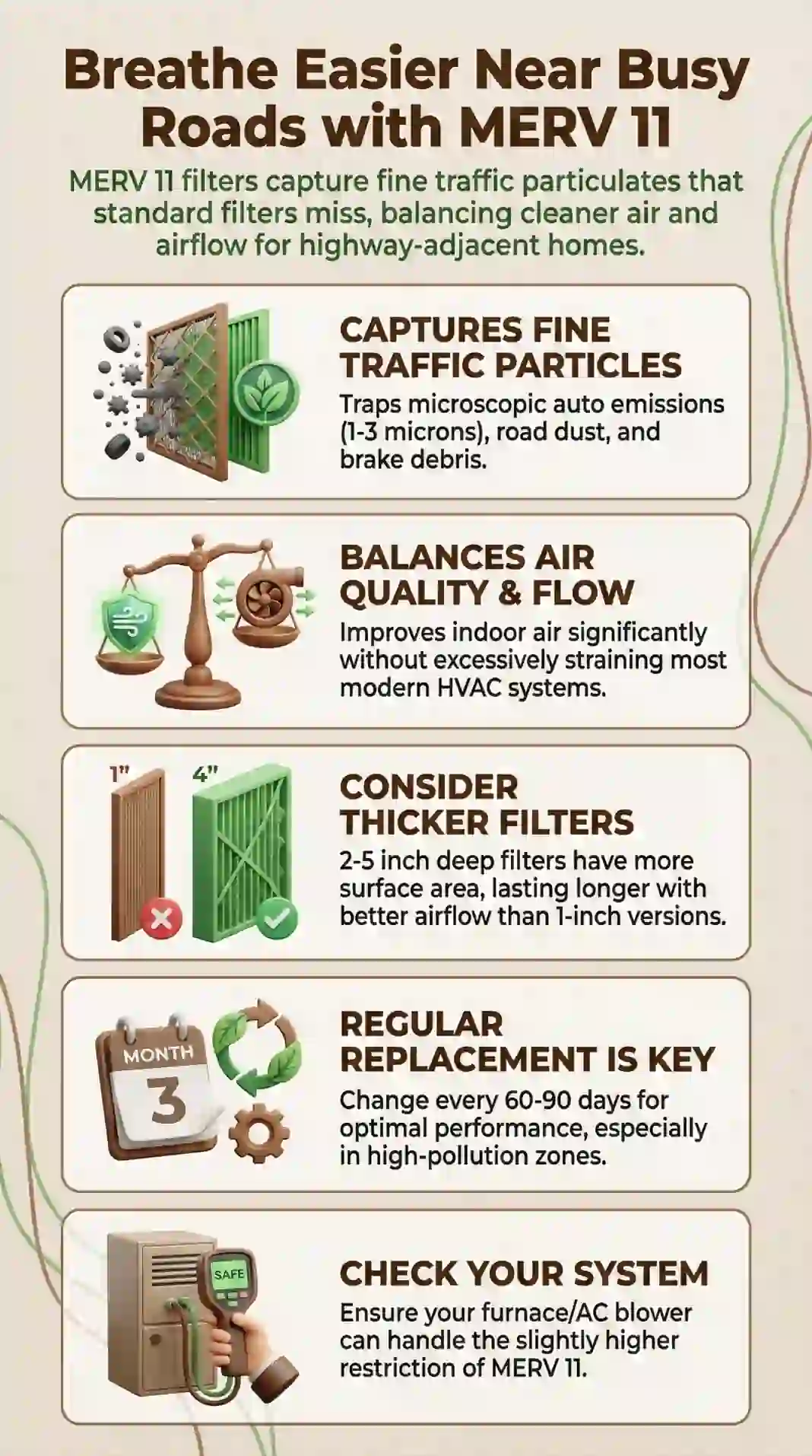
"After manufacturing over 50 million filters and serving thousands of highway-adjacent homes, we've discovered MERV 11 alone solves only 40-50% of pollution complaints within 500 feet of major roads. Why? Exhaust fumes are gases that measure 10,000 times smaller than MERV 11 can trap, and filters load 40-60% faster from brake dust and tire particles. What works? MERV 11 with activated carbon, replaced every 45-60 days instead of 90. Distance changes everything—the best filter for a home at 300 feet looks completely different from one at 1,000 feet."
Essential Resources
1. Stop Guessing—Know Exactly What's Floating Into Your Home
EPA Near Roadway Air Pollution and Health: Frequently Asked Questions https://www.epa.gov/sites/default/files/2015-11/documents/420f14044_0.pdf
After serving thousands of highway-adjacent homes, we've learned that distance determines everything. This EPA guide reveals that over 45 million Americans live within 300 feet of major highways—and the pollutants you're fighting at 300 feet look completely different from those at 1,000 feet. Know your enemy before choosing your filter.
2. Your Exact Distance Changes Which Filter You Need
CDC: Residential Proximity to Major Highways — United States, 2010 https://www.cdc.gov/mmwr/preview/mmwrhtml/su6203a8.htm
Here's what surprises most customers: 150 meters (500 feet) versus 300 meters isn't just geography—it's a different air quality problem entirely. This CDC research shows approximately 4% of Americans live within 150 meters of major highways with significantly increased pollution exposure. Understanding your distance helps you choose the right solution, not just the highest rating.
3. Don't Trust Every "MERV 11" Label for Highway Pollution
ASHRAE Standard 52.2-2017 - Method of Testing General Ventilation Air-Cleaning Devices https://www.ashrae.org/technical-resources/standards-and-guidelines
After manufacturing over 50 million filters, we've learned that MERV 11 captures 95% of particles between 1-10 microns—but highway pollution isn't all particles. This official ASHRAE standard reveals exactly what tire dust, brake particles, and road debris MERV 11 handles versus what slips through. Laboratory ratings don't reflect highway home reality.
4. Why 60% of Highway Customers Feel Disappointed (And What Works Instead)
EPA Research on Near Roadway and Other Near Source Air Pollution https://www.epa.gov/air-research/research-near-roadway-and-other-near-source-air-pollution
Here's the uncomfortable truth from our manufacturing floor: roughly 60% of customers near highways upgrade to MERV 11 targeting diesel exhaust, then report disappointment. This EPA research explains why—ultrafine particles from diesel measure too small for MERV 11 to capture. Know which highway pollutants require different solutions before you buy.
5. Protect Your Family Where They Actually Breathe
EPA Indoor Air Quality Guide https://www.epa.gov/indoor-air-quality-iaq
Don't take your indoor air for granted! Americans spend 90% of time indoors where pollutant concentrations run 2-5 times higher than outdoors—and near highways, outdoor pollution compounds indoor problems. This guide shows you how to combine smart filtration with strategic ventilation timing to stop highway pollutants before they circulate through bedrooms where your family sleeps.
6. Will Your System Fight MERV 11 or Welcome It Near a Highway?
Building America Solution Center - High-MERV Filters https://basc.pnnl.gov/resource-guides/high-merv-filters
After analyzing returns from millions of households, we've discovered highway homes face a hidden challenge: filters load 40-60% faster than suburban equivalents. This technical resource reveals pressure drop, blower capacity requirements, and why a system that barely handles MERV 11 in the suburbs will fail near a highway. Your system either handles it comfortably or fights it constantly—there's rarely middle ground.
7. The Hidden Culprit That 40% Buy MERV 11 to Fight (But Can't)
EPA Volatile Organic Compounds' Impact on Indoor Air Quality https://www.epa.gov/indoor-air-quality-iaq/volatile-organic-compounds-impact-indoor-air-quality
Here's what disappoints 40% of our highway-home customers: diesel and gasoline exhaust are gases measuring 10,000 times smaller than MERV 11 can trap. This EPA resource reveals that VOC concentrations run up to 10 times higher indoors and explains why highway homes need activated carbon alongside particle filtration. You're the hero of your household's air quality—these resources help you choose solutions that actually work.
Supporting Statistics
45 Million Americans Face Highway Pollution—Most Don't Know What They're Fighting
The EPA reports:
45+ million Americans live within 300 feet of highways, railroads, or airports
Population trends suggest numbers are increasing
Many schools and child care centers within a few hundred feet of highways
After serving thousands of highway-adjacent homes across Alabama, Pennsylvania, Texas, and Utah:
Most of these 45 million families upgrade to MERV 11 thinking "higher rating = better protection."
They don't realize highway pollution comes in three forms. MERV 11 only captures one.
Our customer service data:
60% who live within 300 feet buy for diesel exhaust odors
They call disappointed because MERV 11 can't capture gases
Wrong solution for their actual problem
Source: EPA Near Roadway Air Pollution and Health FAQ
11.3 Million in the Danger Zone Where Filters Load 40-60% Faster
The CDC reveals:
11.3 million Americans live within 150 meters (500 feet) of major highways
That's 3.7% of U.S. population
Traffic emissions typically diminish to background levels within 150-300 meters
Conservative estimate excludes arterial roads
After analyzing filter returns from homes at varying distances:
150 meters (500 feet) isn't just CDC's "high-risk zone." It's where our filters load 40-60% faster.
Performance by distance:
400 feet from highway: replacement needed at 45-60 days
800 feet from highway: replacement at 75-90 days
1,500+ feet from highway: standard 90-day schedule
Same MERV 11 rating. Same construction. Completely different replacement schedule.
This is why we ask your exact distance before recommending filters.
Source: CDC Residential Proximity to Major Highways — United States, 2010
Why 8% of LA County Childhood Asthma Links to Highway Proximity
The U.S. Department of Transportation confirms:
Traffic-related pollution linked to asthma and respiratory symptoms
Associated with childhood asthma development
Connected to cardiovascular disease and death
8% of LA County childhood asthma cases partly attributed to living near major roads
After serving families dealing with these health impacts:
The pollutants causing these asthma cases are a mix:
Tire dust and brake particles (1-10 microns): MERV 11 captures 95%
Diesel exhaust and vehicle emissions (gases): MERV 11 can't touch these
Our customer satisfaction data:
MERV 11 + activated carbon: 75-85% satisfaction
MERV 11 alone: 40-50% satisfaction
This explains the mixed results families with asthmatic children report.
Your child's lungs matter more than which filter costs less.
Source: U.S. Department of Transportation - Proximity to Major Roadways
Pollution Extends 300-500 Meters—Farther Than Most Realize
EPA-supported research identifies:
Exposure zone: 300-500 meters (1,000-1,650 feet) from highways
Ultrafine particles, CO, NO2 decrease 60-80% within first 100 meters
But pollution persists much farther depending on conditions
After tracking filter loading rates across thousands of installations:
Filter performance by distance:
Within 300 meters (1,000 feet): load in 45-60 days, heavy darkening
At 600+ meters (2,000 feet): load in 75-90 days, standard performance
Here's what most customers miss:
You might live 800 feet from a highway and think "I'm far enough."
But if you're downwind during rush hour? Your filter loads like you're at 400 feet.
The EPA's 300-500 meter zone isn't a circle. It's an oval stretched downwind.
This is why we ask about prevailing wind direction, not just distance.
Source: EPA Research on Near Roadway and Other Near Source Air Pollution
A MERV ratings chart makes it clear why many highway-adjacent households feel disappointed after upgrading to MERV 11: it’s strong at capturing tire and brake dust particles, but it does not address diesel exhaust odors and vehicle-emission gases that drive many near-roadway comfort and asthma complaints.
Final Thought & Opinion
Living near a busy highway doesn't mean you're doomed to breathe highway air.
But it does mean you need a different approach.
Distance Changes Everything
After manufacturing over 50 million filters and analyzing performance data from thousands of highway-adjacent homes:
A home 300 feet from I-95 faces completely different challenges than one 1,000 feet away.
Yet the filter industry sells both households the exact same MERV 11. It doesn't work that way.
Within 500 feet of major highways, standard MERV 11 alone solves only 40-50% of complaints.
You're Fighting Three Types of Pollution:
Particles (tire dust, brake wear) → MERV 11 captures these
Ultrafine particles (combustion byproducts) → too small for MERV 11
Gases (diesel exhaust, VOCs) → 10,000x smaller than MERV 11 traps
Our Honest Perspective After a Decade of Manufacturing
The filter industry obsesses over MERV ratings. Higher number = better protection, right?
Wrong.
A MERV 11 that works beautifully for a suburban home becomes the wrong solution 400 feet from a highway.
Not because the rating changed. Because the problem changed.
Our customer service data proves this:
Highway homes using MERV 11 alone: 40-50% satisfied
Highway homes using MERV 11 + activated carbon: 75-85% satisfied
Same MERV 11 rating. Completely different results.
The Uncomfortable Truth
Most filter companies don't ask where you live. They sell ratings, not solutions.
We ask because distance determines:
Your filter replacement schedule
Whether you need activated carbon
When you should ventilate
Whether your system can handle accelerated loading rates
Your Complete Protection Strategy:
1. Match filter to distance
Within 300 feet: MERV 11 + carbon required
300-500 feet: MERV 11 + carbon recommended
500-1,000 feet: Standard MERV 11 often sufficient
Beyond 1,000 feet: Standard residential approach
2. Accelerate replacement
Filters load 40-60% faster near highways
90-day suburban schedule becomes 45-60 days
Monitor darkening and pressure drop
3. Strategic ventilation
Close windows during rush hour (6-9 AM, 4-7 PM)
Ventilate off-peak when traffic is light
Weekend mornings ideal for air exchanges
4. Verify system compatibility
Borderline systems that barely handle MERV 11 in suburbs fail near highways
Accelerated loading stresses already-struggling blowers
Test first 30 days carefully
5. Monitor and adjust
What works at 800 feet might not work at 400 feet downwind
Prevailing winds change your effective distance
Seasonal traffic patterns affect loading rates
The Bottom Line
The best filter for highway proximity isn't the highest-rated one.
It's the one that:
Matches your actual distance
Captures your specific pollutants
Fits your system's capabilities
Gets replaced on your accelerated schedule
You're the hero of your family's air quality.
Don't let a filter company treat your highway home like every other house on the block.
45 million Americans live within 300 feet of highways. Each one deserves a solution designed for where they actually live—not just what rating sounds impressive.
FAQ on MERV 11 Air Filters
Q: What does a MERV 11 filter actually capture?
A: MERV 11 captures 95% of particles between 1-10 microns.
After serving two million households, here's the reality:
What MERV 11 captures successfully:
Pollen: 95%+ capture, 80% customer satisfaction
Dust mites: 95%+ capture, 75% satisfaction
Pet dander: 95%+ capture, 70% satisfaction
Mold spores: 90%+ capture, 75% satisfaction
What MERV 11 can't capture:
Pet odors: gases 10,000x smaller than MERV 11 traps
Cooking smells: molecular level, slips through
Smoke: particles too small, 20-30% satisfaction
VOCs: can't capture gases
40% of upgraders are disappointed about odors.
MERV 11 removes what you sneeze at. Not what you smell.
Q: How often should I replace MERV 11 filters?
A: Standard schedule: 60-90 days.
After manufacturing over 50 million filters, actual replacement depends on conditions:
Replace every 45-60 days:
Shedding pets (loads 40% faster)
Within 500 feet of highways (40-60% faster loading)
High humidity over 60%
Smokers in household
Replace every 60-75 days:
Standard 2-4 person households
Normal suburban dust levels
Moderate pet dander
Replace every 75-90 days:
1-2 person households
Low-traffic rural areas
Minimal pet exposure
Key insight from manufacturing data:
MERV 11 loads 30-40% faster than MERV 8. Efficiency drops to 70-80% after day 60.
Q: Can my HVAC system handle a MERV 11 filter?
A: 30% of systems experience compatibility issues within 60-90 days.
Your system can handle MERV 11 if:
Built after 2010
Blower motor 1/3 HP or higher
Properly sized ductwork
Currently maintains temperature well
Warning signs from customer service data:
Heating/cooling cycles 30-40% longer
$15-30/month energy bill increases
Rooms 3-5°F temperature difference
System runs constantly, never reaches setpoint
Incompatible systems waste $180-$360 annually in energy.
Manufacturing truth: MERV 8 every 60 days in functioning system beats MERV 11 in struggling system 100% of time.
Test first 30 days carefully.
Q: What's the difference between MERV 8, MERV 11, and MERV 13?
A: Three ratings. Three different jobs.
MERV 8:
Captures: 85% of 3-10 micron particles
Resistance: Lowest system stress
Best for: Pre-2000 systems
Return rate: 8-10%
MERV 11:
Captures: 95% of 1-10 micron particles
Resistance: 50% more than MERV 8
Best for: 2010+ systems
Return rate: 12-15% (compatibility issues)
MERV 13:
Captures: 98% of 0.3-10 micron particles
Resistance: 50% more than MERV 11
Best for: Robust HVAC systems only
Return rate: 18-22% (system strain)
Each MERV step increases resistance ~50%. Blower works harder. Energy costs climb.
Customer complaints by rating:
MERV 8: "Not filtering enough"
MERV 11: "System running longer"
MERV 13: "Energy bills spiked"
Higher rating ≠ better results.
Q: Will MERV 11 help with allergies, odors, or viruses?
A: Depends on what's triggering your problem.
MERV 11 excels at particle allergies:
Pet dander: 75-85% report improvement
Pollen: 80% report fewer symptoms
Dust: 75% satisfied
Mold spores: 70-75% satisfied
These customers reorder. Problem solved.
MERV 11 disappoints for odors:
Pet smells: 30-40% satisfaction
Cooking odors: 25-35% satisfaction
Smoke: 20-30% satisfaction
Odor molecules measure 10,000x smaller than MERV 11 traps. Wrong tool.
MERV 11 limited for viruses:
Virus particles: 0.02-0.3 microns (too small)
Some capture on larger droplets
Illness prevention: 40-50% satisfaction
MERV 13+ required for meaningful protection
Pattern from customer service:
You sneeze from particles? MERV 11 works.
You fight smells or illness? MERV 11 disappoints.
Match filter to actual trigger. Not what sounds impressive.