So what changed? Canada's fires are burning closer and hotter than they used to, and Michigan sits squarely in the wind's path. I went through the state's alert records and the research behind them to piece the story together. Here's what I found, and what it means for the air inside your home.
TL;DR Quick Answers
wildfire smoke Michigan
Wildfire smoke in Michigan arrives most summers, mostly from Canadian fires in Ontario, Quebec, and Manitoba that northwest winds carry south. EGLE issued its first PM2.5 smoke alert in 2023 and called 23 PM2.5 alert days in 2025. Protect your home by closing windows, setting your fan to On, and running a MERV 13 filter.
Where it comes from: Mostly Canada’s boreal forest, plus occasional local fires like the ones behind the October 2026 Upper Peninsula alert.
When it hits: Usually June through August, with alerts reaching into October in 2026.
Who feels it first: Kids, older adults, pregnant people, and anyone with asthma, COPD, or heart disease.
What to do indoors: Check your filter every two weeks during smoke events and swap it once it turns gray, since smoke loads pleats far faster than household dust.
How to stay ahead: Watch MiAir for live readings and sign up for EnviroFlash alerts for your ZIP code.
Top Takeaways
Smoke is now routine. Michigan went from its first PM2.5 alert in June 2023 to 23 PM2.5 alert days in 2025.
The fires moved closer. Recent Canadian fire seasons have centered on Ontario, Quebec, and Manitoba instead of the far west.
Geography and weather finish the job. Northwest winds steer plumes south, and sinking air pulls the smoke down to ground level.
The season keeps stretching. Michigan saw smoke alerts as late as October 12 in 2026.
Your indoor air is yours to protect. Closed windows, a fan set to On, and a MERV 13 filter do the heavy lifting.
What Has Changed in Michigan's Smoke Seasons
Smoke went from rare to routine here in four years. Follow the alerts and you can watch it happen.
2023, a first for the state. On June 4, 2023, the Michigan Department of Environment, Great Lakes, and Energy (EGLE) issued its first-ever air quality alert for PM2.5, the fine particles that make up most wildfire smoke. Every Michigan alert before that one had targeted ozone.
2025, smoke takes over. EGLE called 31 alert days in 2023 and another 31 in 2025, but the reason shifted. PM2.5 alert days climbed from 14 to 23, and the 2025 smoke stayed for most of the summer.
July 2026, a new high. Canadian smoke pushed Upper Peninsula readings past 500, the top of the official AQI scale, for days at a stretch. EGLE reported concentrations above the 2023 and 2025 events.
October 2026, a longer season. Local wildfires in Marquette and Baraga counties prompted EGLE to issue an alert for five western Upper Peninsula counties on October 12. Smoke season used to mean July.
Why Canadian Wildfires Reach Michigan More Often
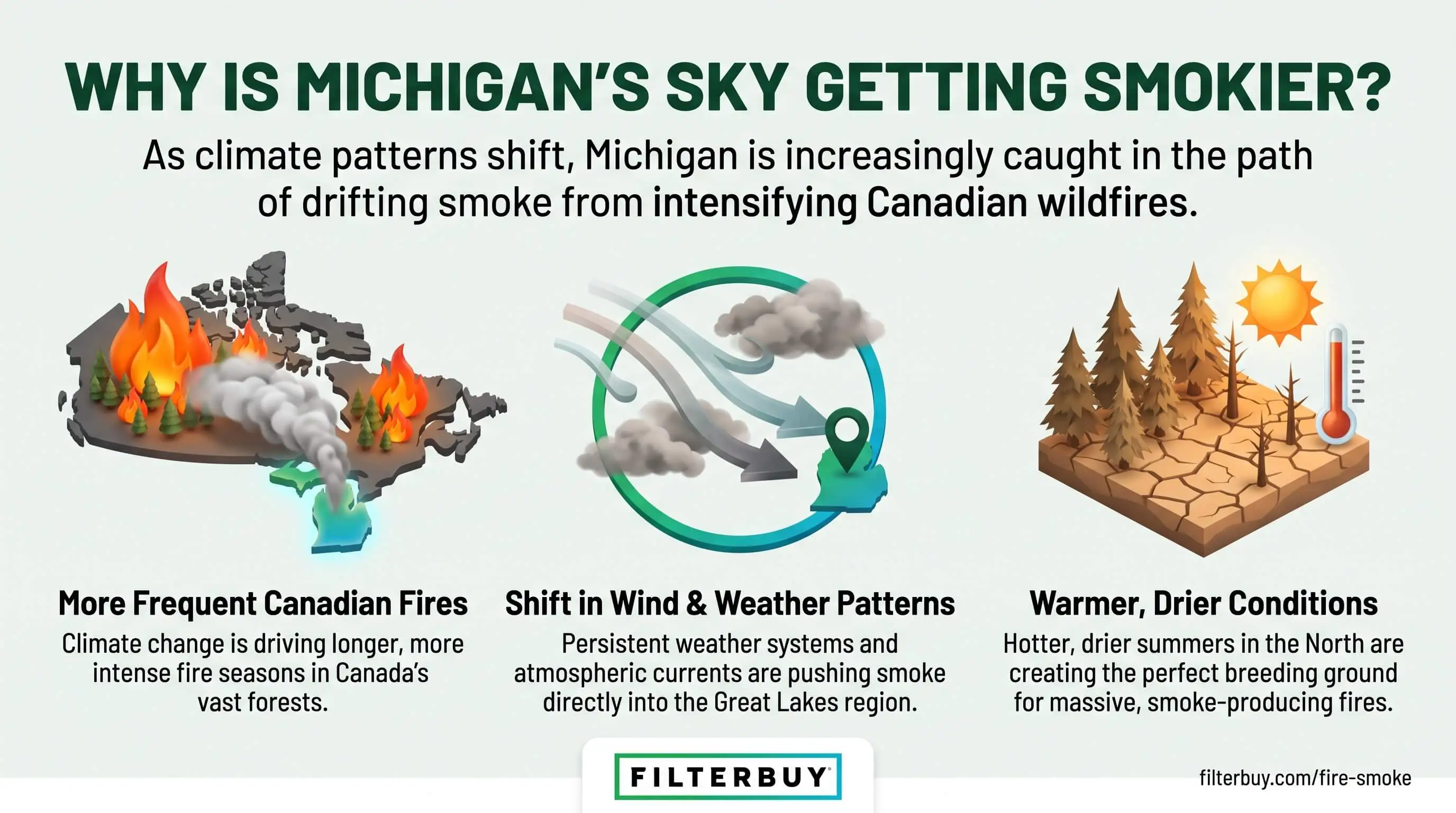
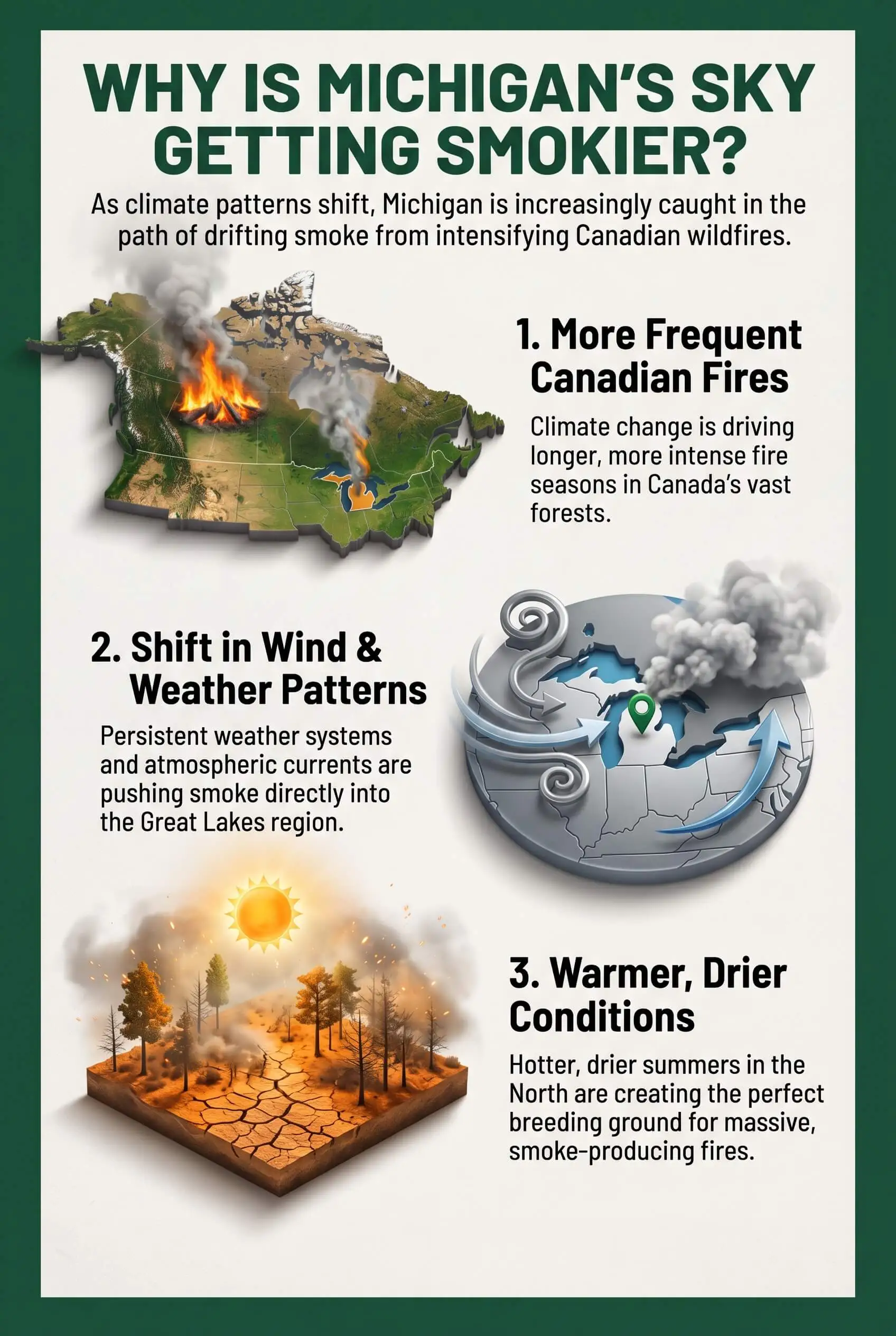
Most of the smoke over Michigan starts in Canada's boreal forest. That forest has changed in ways that send more of it our way.
Fire Activity Has Moved Closer to the Great Lakes
Canada's worst fire years once centered on British Columbia and Alberta. Smoke from that far west thins out on the long trip and usually rides high overhead. In 2023 and again in 2025, an EGLE meteorologist saw the fires concentrate in central and eastern Canada, across Ontario, Quebec, and Manitoba. Shorter trip, thicker smoke.
Hotter, Drier Summers Feed Bigger Fires
Warm, dry springs turn the boreal forest into kindling, and lightning strikes supply the spark. By early August 2023, Canada had already burned about double the area it loses in a normal full season. Researchers link the trend to a warming climate, but they also admit nobody can predict a single season with confidence.
Decades of Fire Suppression Left More Fuel
For generations, crews snuffed out fires near towns and roads as fast as they could. That kept communities safe. It also let dead wood and thick brush pile up for decades, so when those forests burn now, they burn bigger and hotter.
Why Michigan's Geography Puts It in the Smoke Path
Michigan shares land and water borders with Ontario to the north, northeast, and east. Look at a map and the Upper Peninsula practically points at the Canadian fire zones. Marquette, Houghton, and the Keweenaw often smell smoke a day before anyone in Detroit or Grand Rapids does.
Northwest Winds Carry Smoke South
Smoke goes where the wind sends it. With high pressure parked southeast of the Great Lakes and low pressure to the northeast, air pours in from the northwest and crosses the region head-on. Then a cold front comes through and shoves the plume south, from the Upper Peninsula through the northern Lower Peninsula and down to the Indiana line, often in a single day.
When High Smoke Drops to Ground Level
Here's something that might surprise you. A hazy orange sky doesn't always mean bad air at street level, because distant smoke often sits thousands of feet up. Trouble starts when sinking air under a high-pressure system, or a calm night with a temperature inversion, drags that smoke down to where your family breathes. Ever notice a smoky week feels worse at 6 a.m. than it did the afternoon before? That's why.
What More Smoke Means for Your Air
The danger in smoke is the part you can't see. PM2.5 particles measure about 1/30 the width of a human hair, small enough to slip past your nose and throat and settle deep in your lungs. Some cross into the bloodstream. Kids, older adults, pregnant people, and anyone with asthma, COPD, or heart disease feel it first. While air duct cleaning can remove accumulated dust and debris, proper air filtration is essential for reducing fine smoke particles indoors.
The Air Quality Index colors tell you when to change plans.
Orange (101 to 150): Sensitive groups should limit time outdoors.
Red (151 to 200): Everyone should cut back on outdoor activity.
Purple and maroon (201 and up): Stay inside with filtration running.
Don't take your indoor air for granted on smoky days! Fine particles sneak in around doors and windows, through fresh-air intakes, and behind exhaust fans that pull outdoor air in to replace what they push out. Unless something filters it, the smoke outside ends up in your living room. That's why it's important to test indoor air quality during wildfire smoke events to see how much pollution is making its way inside.
How to Track Smoke and Protect Your Indoor Air
What your family breathes at home is up to you, and that starts with knowing what's coming.
Check MiAir and sign up for EnviroFlash. EGLE's MiAir dashboard shows live readings from monitors statewide, and EnviroFlash texts or emails free alerts for your ZIP code.
Watch the smoke forecast. Smoke maps show where plumes are headed a day or two before they arrive.
Once smoke is in the forecast, get your home ready.
Close windows and doors, especially overnight, when smoke settles lowest.
Switch the thermostat fan from Auto to On so air keeps cycling through your filter around the clock.
Run a MERV 13 filter or the highest rating your system can handle. This MERV ratings chart explains what each number catches.
Set up one clean room with a portable HEPA purifier where sensitive family members can sleep.
Check the filter every two weeks during smoke events and swap it once it turns gray.
Pro Tip: Look up your filter size in late spring and keep a spare MERV 13 on the shelf. Smoke can load a filter in a matter of weeks, and the middle of a smoke event is a bad time to find out you're out. Our neighbors to the west fight the same smoke, as this look at air quality in Minnesota shows.
"In my years pulling HVAC filters during Michigan smoke weeks, I've seen a filter rated for three months turn gray in under four weeks, because PM2.5 from Canadian smoke packs into the pleats far faster than household dust. When indoor readings creep up even with the windows shut, a loaded filter is the first thing I check."
7 Essential Resources
Live Michigan Wildfire and Smoke Map: See active fires, smoke plumes, and air quality readings across Michigan, plus tips for keeping smoke out of your home.
EGLE: Wildfire Smoke: Learn how Michigan forecasts smoke and calls alerts, with links to MiAir and EnviroFlash.
AirNow: Reduce Your Smoke Exposure: Simple steps for staying safer indoors and outside when smoke rolls in.
EPA: Wildfires and Indoor Air Quality: How smoke gets into homes and how your HVAC filter helps keep it out.
CDC: How Wildfire Smoke Affects Your Body: The health effects of smoke and who faces the greatest risk.
American Lung Association: Wildfire Smoke and Lung Health: Clean room setup, symptoms to watch for, and lung health advice.
ASHRAE Wildfire Response Resources: The engineering group's guidance on protecting indoor air during smoke events.
3 Supporting Statistics
Wildfire smoke has slowed or reversed PM2.5 improvements in two-thirds of U.S. states since 2016, wiping out 23% of earlier air quality gains on average, according to a National Bureau of Economic Research paper. NBER Working Paper w30882
Canadian wildfires burned 13.5 million hectares by August 10, 2023, roughly double what the country loses in a typical full season. NASA Earth Observatory
During the June 2023 Quebec smoke wave, asthma emergency visits in New York City ran 44% higher than normal, according to a study archived by the National Library of Medicine. PubMed Central
Wildfire smoke has erased years of air quality improvements across the U.S., while Canada's record-breaking 2023 fires sent dangerous fine particles into communities, contributing to a 44% increase in asthma emergency visits in New York City during the June smoke wave. Replacing an AC air filter regularly can help reduce the buildup of smoke particles indoors and maintain cleaner air during wildfire events.
Final Thoughts and Opinion
My honest take? Michigan now has a smoke season, and it's time we planned for it like one. Nobody in Lansing or Marquette can stop a fire burning hundreds of miles north. The air inside your home is a different story. Close up when the alerts come, keep the fan running through a good filter, and give your most sensitive family members a clean room to retreat to. Handle smoke prep alongside your spring furnace check, and you'll be the hero of your household when the next hazy morning rolls in.
Frequently Asked Questions
Is Wildfire Smoke in Michigan Getting Worse Every Year?
Not in a straight line, since quiet years like 2024 still happen. The overall trend points up, though, with more smoke-driven alert days and heavier events in 2023, 2025, and 2026.
Where Does Michigan's Wildfire Smoke Come From?
Most of it blows in from Canadian fires in Ontario, Quebec, and Manitoba. Some drifts over from western Canada, Minnesota, or the western U.S., and occasionally Michigan has fires of its own.
When Is Wildfire Smoke Season in Michigan?
Canada's fire season runs roughly May through September, and Michigan usually gets its worst smoke in June, July, and August. In 2026, the alerts kept coming into October.
Is Wildfire Smoke Dangerous if the Fire Is Hundreds of Miles Away?
Yes. PM2.5 can travel more than a thousand miles and still hit unhealthy levels, especially once sinking air drags it to the ground.
How Do I Get Michigan Air Quality Alerts?
Sign up for EnviroFlash through EGLE and you'll get free email or text alerts for your ZIP code. MiAir shows live readings anytime.
What Filter Should I Use for Wildfire Smoke in Michigan?
Use a MERV 13 filter, or the highest rating your HVAC system can handle. It catches most of the fine particles in smoke.
Stay Ahead of Michigan's Smoke Seasons
Michigan is getting more wildfire smoke than it used to, and a little prep before each summer keeps that smoke outside where it belongs. Bookmark a live smoke map, sign up for local alerts, and keep a high-efficiency filter ready for the next hazy week.