I didn't take that seriously until July 15 last year. A sensor in West Duluth logged 617.8 micrograms of fine particles per cubic meter that morning, the highest hourly reading the state has ever recorded, and by afternoon the Twin Cities sat under a maroon alert for the first time. Maroon is the worst category on the scale. Most people I know spent that day inside, wondering whether inside was actually helping.
Often it wasn't. That's the part I want to get to.
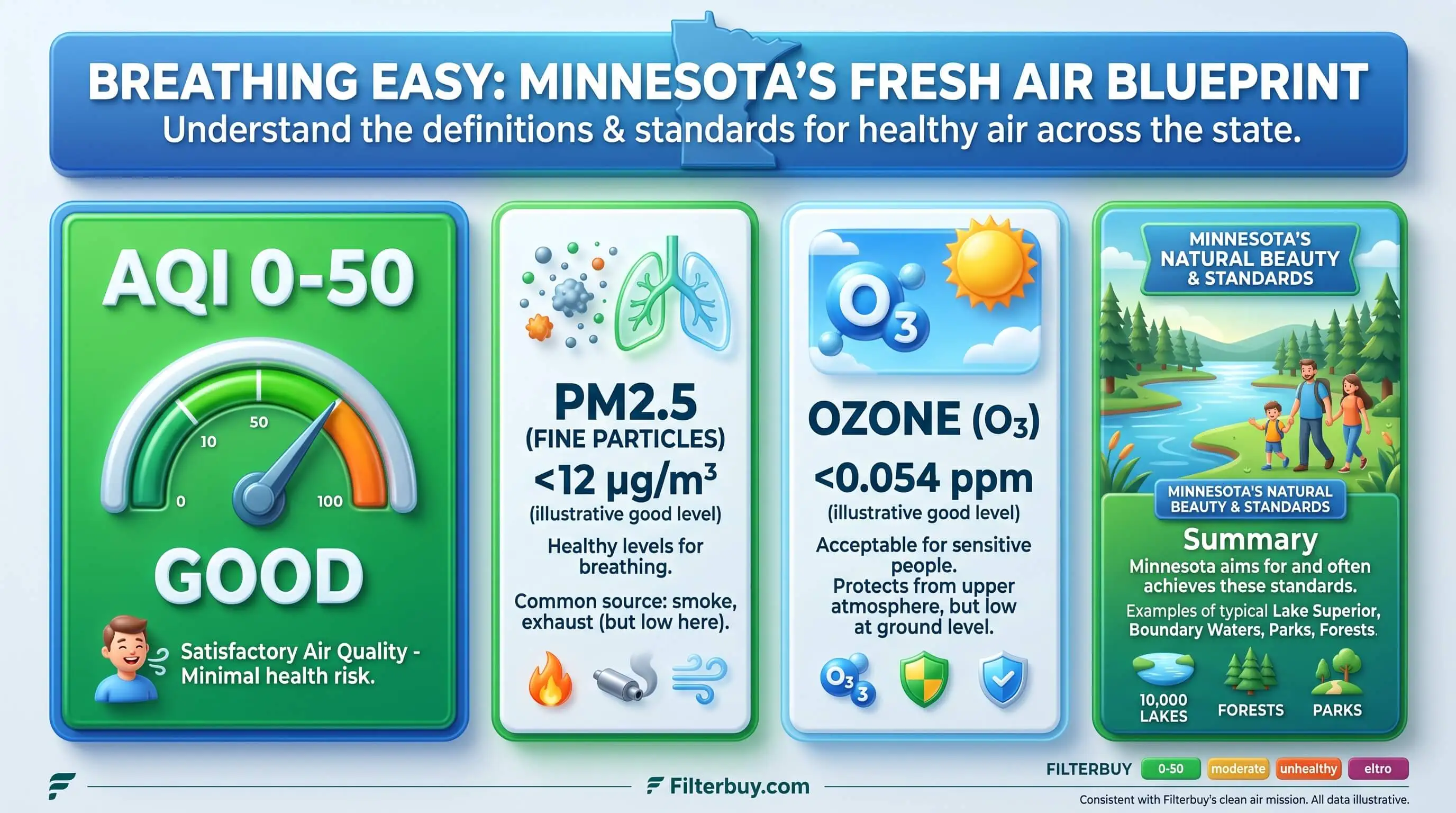
So: good air quality in Minnesota means an AQI of 50 or lower. Moderate runs 51 to 100. Once you're above 100, somebody in your house should be changing their plans. That scale moved in 2024, though, and plenty of the advice still floating around online was written under the old version.
TL;DR Quick Answers
Air Quality Minnesota
Air quality in Minnesota is good at an AQI of 0 to 50 and moderate from 51 to 100. Wildfire smoke pushes the state past 100 more often than anything else, usually between June and August. What most people miss is that the outdoor number sets the indoor number within an hour or two, so a clean filter counts as much as the forecast does.
Then the existing eight quick-answer bullets follow underneath.
Top Takeaways
Good air here means 0 to 50 on the index. Moderate runs to 100. Past that, sensitive people start feeling it before anyone else does.
More yellow days on your app doesn't automatically mean dirtier air, because the good range tightened in May 2024.
Smoke drives the worst days, ozone has hot afternoons, and winter inversions trap wood smoke after dark.
Read the monitor nearest you. A statewide figure buries the gap between the Arrowhead and the southern counties.
Indoor air trails outdoor air by an hour or two, which puts your filter and your ductwork among the few things you genuinely control.
The Safe AQI Range in Minnesota
The index runs from 0 to 500 across six categories, and lower is cleaner. Here's what each one actually asks of a household up here.
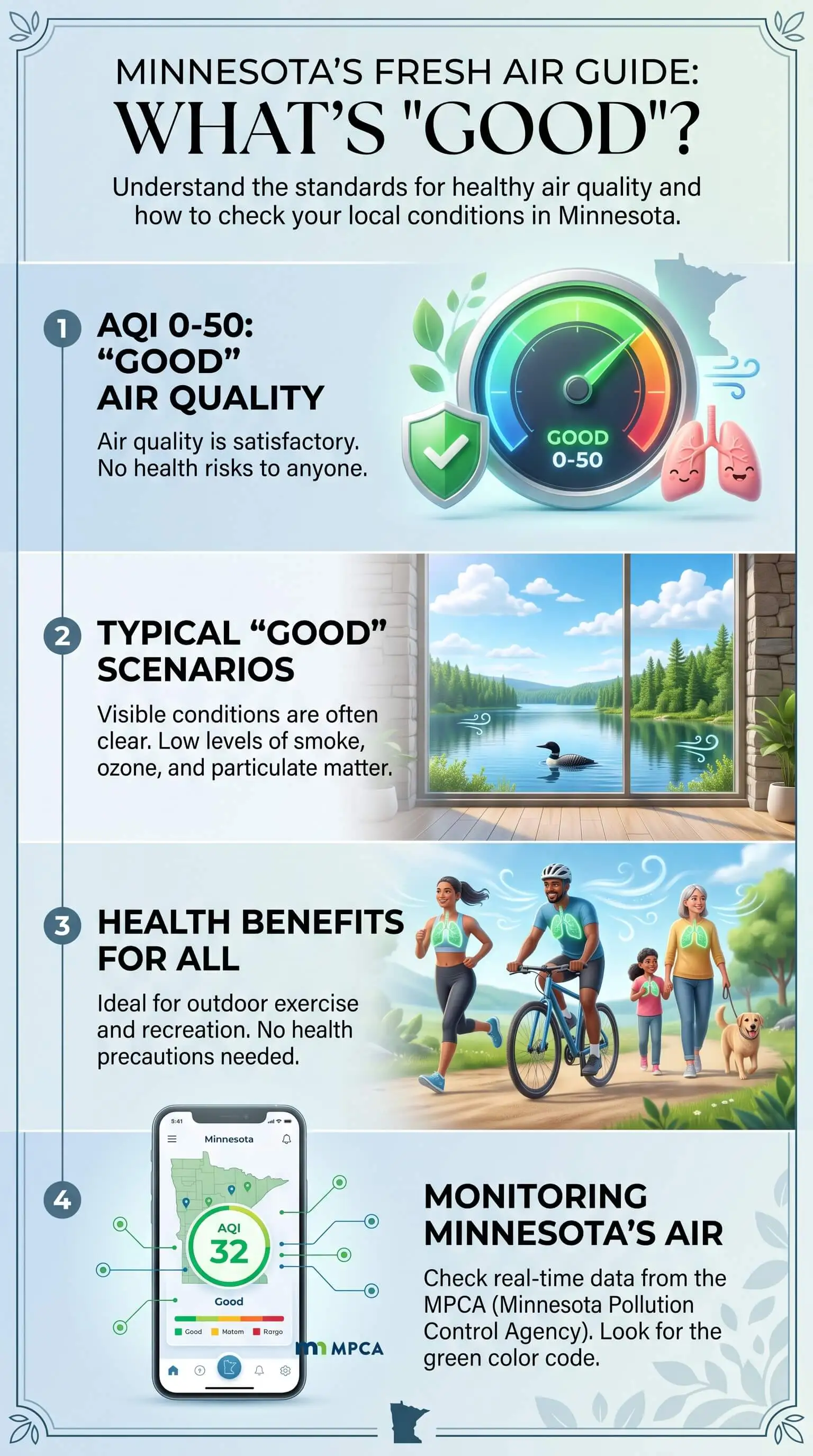
0 to 50, good, green. Little or no risk to anyone. Open the windows and go do whatever you had planned.
51 to 100, moderate, yellow. Fine for nearly everyone, though a sensitive person might feel it on a long run or a hard afternoon in the yard.
101 to 150, unhealthy for sensitive groups, orange. Kids, older adults, and anyone with asthma or a heart or lung condition should ease off outdoor exertion. Most Minnesota smoke alerts land right here.
151 to 200, unhealthy, red. Everybody feels this one, so move anything long or strenuous indoors.
201 to 300, very unhealthy, purple. A health alert. Stay in and filter what you're breathing.
301 and up, hazardous, maroon. Emergency conditions, and nobody should be outside for long.
One statewide figure won't tell you much about a place this size, so it's worth pulling up a live air quality index map for Minnesota and reading whichever monitor sits closest to you. Duluth and Rochester land in different categories all the time on the same afternoon.
Why Good Got Stricter
Here's the piece that trips people up. In May 2024 the EPA tightened the fine particle concentration behind an AQI of 50, dropping it from 12.0 to 9.0 micrograms per cubic meter. Nothing happened to the air itself, but the grading got harder.
So you're seeing more yellow days now for air that would have come back green a few years ago. I noticed the shift on my own forecast app a full season before I understood why. If you land on a page still quoting 12.0 as the top of the good range, it was written under the old rules and nobody has touched it since.
What Pushes Minnesota Past 50
Wildfire smoke does most of the damage. For years the source was almost entirely Canadian, drifting down out of Saskatchewan, Manitoba, and Ontario, and then in 2026 the state supplied its own. Smoke carries particles small enough to reach deep into your lungs. It can show up at any hour and sit for days.
Ozone is the summer afternoon problem. Heat and sunlight cook exhaust and industrial emissions into it, which is why it peaks midafternoon, fades after sunset, and leaves early morning and evening as your cleanest hours. The Twin Cities suburbs and the Rochester area take the worst of it.
Then there's the one almost nobody talks about. On a cold, still winter night, warmer air can cap the cold air near the ground and hold wood smoke and exhaust right where you're breathing it. Local readings climb after dark and settle by morning.
The Geography Actually Matters
Minnesota covers a lot of ground, roughly 400 miles north to south, and the monitoring network thins out in the west and northwest compared with the metro. A plume can leave the Arrowhead sitting in orange while the southern counties stay green, then flip a day later.
Which makes a statewide average close to useless for deciding whether your kid can play outside. Read your monitor, not your state.
What I Do at Each Level
Nothing complicated survives a busy week, so mine is short.
Under 100. Live normally. Windows open, filter changed on schedule.
101 to 150. Windows shut, and I switch the thermostat fan from Auto to On so the system keeps pulling air through the filter instead of running only when it's heating or cooling. Then I pull the filter and look at it.
151 and up. Anything strenuous moves inside, the system runs continuously, and a portable cleaner goes in whichever room we're using.
201 and up. Seal the house, set the system to recirculate rather than draw outside air, and quit opening doors more than I have to.
The Part Most Air Quality Pages Skip
Outdoor air doesn't politely stay outdoors. Fine particles slip in around windows and doors, ride in through the return, and indoor levels follow the outdoor number within an hour or two. Since we spend the bulk of our lives inside, the air in your house is the air you're actually breathing. You just can't see it happening.
That's where filtration earns its keep. Federal wildfire guidance points homeowners toward the MERV 8 filter, or the highest rating your system can handle without choking airflow, because that's the level built to catch fine particles. A loaded filter can't do that job. Smoke packs one in weeks instead of months, and I've pulled filters after a bad stretch that looked closer to gray felt than pleated white paper.
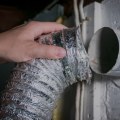
Ductwork works the same way. Particles that settle in there don't stay put, which is why duct cleaning can matter when buildup becomes significant, and every time the blower kicks on some of them lift right back into the air you breathe. A restricted dryer vent piles onto the same load, pushing lint, humidity, and fine particulate into the house instead of out of it.
"The mistake I see most often is treating the AQI like a weather report you glance at and forget. It's closer to a fuel gauge. After the July smoke I pulled the filter I'd installed eleven days earlier, and it was already gray enough that I wouldn't have left it in another week. The number outside is half the story. What you do with your system in the next hour is the half you control."
7 Essential Resources
Seven I keep one tap away during smoke season. All free, all kept current.
AirNow Fire and Smoke Map. Shows where the smoke and fine particles actually sit, so you see a bad-air day coming instead of guessing.
Minnesota DNR Climate Journal, July 2026 smoke outbreak. The state climatology write-up of last July, including the record concentrations measured at West Duluth and Blaine.
Minnesota Department of Health wildfire smoke guidance. Who's most at risk, and what to do at each AQI level, in plain language.
EPA guide to creating a clean room. Walk you through sealing up, running the fan on On, and using a MERV 13 filter or portable cleaner.
EnviroFlash. Free email and text alerts the EPA runs jointly with your state agency. Set it once and let the forecast do the watching.
CDC wildfire smoke safety guidelines. Practical steps for cutting smoke exposure, with specifics for children and people managing chronic conditions.
Asthma and Allergy Foundation of America on air pollution. Worth reading if someone under your roof has asthma, since symptoms can start before the index even turns orange.
3 Statistics
The good air cutoff dropped by a quarter. The EPA revised the AQI value of 50 from 12.0 to 9.0 micrograms per cubic meter of fine particles, effective May 6, 2024.
12 to 16 smoke days, forecast for a single summer. Minnesota Pollution Control Agency meteorologists predicted 12 to 16 days of wildfire smoke impacts and four to six unhealthy ozone days across the state for summer 2026.
723,418 Minnesota kids. That is how many the American Lung Association counted living with unhealthy air in its 2026 State of the Air report, which ranked the Twin Cities 39th worst in the nation for short-term particle pollution and handed the metro an F.
Choosing top air filters before Minnesota’s smoke and ozone season arrives can give households a simple, positive advantage: cleaner indoor air, better preparedness for sudden pollution spikes, and less need to react after outdoor air quality has already worsened.
Final Thoughts and Opinion
My honest read, after several summers of paying closer attention than is probably normal, is that we've gotten good at checking the number and bad at doing anything with it. The forecast apps are excellent. The habit that should follow them hasn't caught up.
Part of that's framing. Almost every air quality resource treats the outdoor reading as the finish line. Check it, decide whether to run, done. But if you spend most of your day inside, that number is really a heads-up about what's headed into your house over the next couple of hours. Reading it and then leaving a three month old filter in place is like reading a storm warning and leaving the windows open.
I'd also push back on the idea that a bad air day is rare enough to ignore. It was, once. Between Canadian smoke, an ozone season running above average, and now fires inside the state, orange days have turned into a normal feature of a Minnesota summer, which makes keeping fresh pleated furnace filters on hand part of planning ahead. Planning for a dozen of them beats getting surprised by each one.
Frequently Asked Questions
What is a good AQI in Minnesota?
An AQI of 0 to 50 is good, meaning air pollution poses little or no risk to anyone. Readings of 51 to 100 fall into the moderate range, which is acceptable for most people. Anything at or below 100 counts as satisfactory air quality across the state.
Is an AQI of 50 safe?
Yes. An AQI of 50 sits at the top of the good category and is safe for everyone, including kids and people with asthma. It does mean conditions are close to tipping into moderate, so if the trend is climbing, check again before a long stretch outdoors.
What AQI is considered unhealthy in Minnesota?
Air turns unhealthy for sensitive groups at 101, which covers kids, older adults, and anyone with asthma or a heart or lung condition. At 151 it's unhealthy for everyone. Above 200 is a health alert, and above 300 is hazardous, when everyone should stay indoors with filtered air.
When is Minnesota's air quality at its worst?
Late spring through early fall, with the roughest stretches usually landing between June and August. Wildfire smoke drives most alert days, and ground-level ozone adds hot, sunny afternoons. Winter brings a smaller, more local problem when cold, still nights trap wood smoke near the ground.
Should I close my windows when the AQI hits 100?
One hundred is the usual dividing line. Below it, open windows are fine for most households. Above it, close them and run your HVAC system with a clean filter, setting the fan to On rather than Auto so air keeps moving through filtration instead of only during heating or cooling, with professional HVAC system maintenance helping keep that airflow and filtration working as intended.
What to Do Next
Pull up your city and note the number before you plan anything outdoors today, then check it again in the afternoon, because smoke and ozone both move faster than people expect. Then go look at the air conditioner filters in your furnace system. If the last bad stretch came through your house, you'll know in about five seconds whether it needs replacing. That one decision does more for the air your family actually breathes than anything else on this page.